Britton's Coast Violet, Viola brittoniana, is a native herbaceous perennial plant showing in spring the characteristic violet-blue flowers of most violets. However, its distinctive lobed leaves separate it from most other species of violets. Violets are frequently found in shady areas but they are often not recognized as an important part of the eco-system. This species is also known as Northern coastal violet.
Violets have two types of flowers: chasmogamous flowers which are the flowers we normally see and cleistogamous flowers which are not showy, remain closed, and self-fertilize. Here the discussion is about the chasmogamous flowers.
The violet family has a long history of taxonomic confusion and dispute and many hybrids have been found. Since violet species are frequently difficult to identify, the features that are used in a dichotomous key are presented here. These features are useful to help distinguish between the species.
Plant & Leaves
Britton's Coast Violet, Viola brittoniana, plants and leaves:
The first level of characterization of violet species is whether the violet plant is stemmed or stemless.
- Stemmed (caulescent,): The plant produces a stalk with both leaves and flowers. The flowers grow from the leaf axils. Also, basal leaves may or may not be present.
- Stemless (acaulescent): The plant produces separate flower stalks and leaf stalks. The leaf and the flower stalks emerge directly from the ground (rhizomes or stolons). Leaves are all basal.
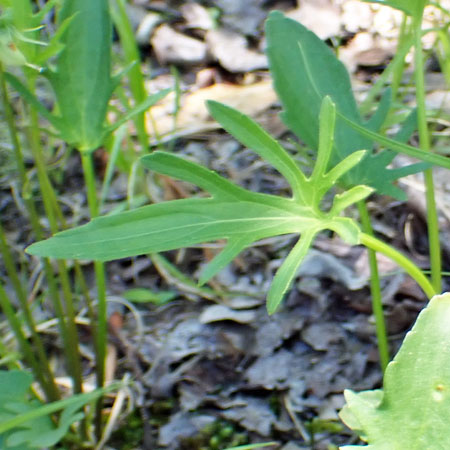
Northern coastal violet, Viola brittoniana is stemless. Its distinctive lobed leaves separate it from most other species of violets. However, there are other species of violets with lobed leaves. In NJ, V. brittoniana is frequently confused with V. palmata and V. subsinuata. All these are stemless and have deeply lobed leaves. Some of the differences are mentioned below.
Britton's Coast Violet, Viola brittoniana, characteristics are:
- plant: stemless (acaulescent), leaves & flower stalks directly from the ground/rhizomes (below ground).
- plant: about 10 inches tall
- flower stalks: upright.
- early leaves: are similar to primary leaves, lobed. (vs. V. palmata early leaves are unlobed)
- primary (later leaves)- leaf/lobes:
- leaves are erect; lobes conspicuous; base truncate to cordate; margins entire; apex acute to obtuse; biternate lobes (3 main lobes, each main lobe further divided into 3 more lobes)
- lobes: middle and lateral blade lobes differ in width and/or shape;
- middle lobes: lanceolate or spatulate to narrowly obovate (wider above the middle);
- lateral lobes: lanceolate or spatulate to falcate (long and curved, sickle shaped)
- leaves and lobes are quite variable; there are other descriptions of the leaves and lobes.
- primary (later leaves)- hairs:
- glabrous (hairless) on their surfaces (vs. V. subsinuata and V. palmata are usually hairy )
- fine hairs along their margins (ciliolate)
- hairs sometimes only along the veins on the underside - appressed-hirtellous (short, stiff hairs that lie flat)
- petioles: The petioles (leaf stalks) are also typically hairless or nearly so. (vs. V. subsinuata and V. palmata are usually hairy)
- peduncles: The peduncles (flower stalks) are also usually hairless (glabrous). (vs. V. subsinuata and V. palmata are usually hairy)
The plant produces separate flower stalks and leaf stalks. The leaf and the flower stalks emerge directly from the ground. Leaves are all basal. The red arrows point to leaves produced earlier in the season that are at the base of the plant.
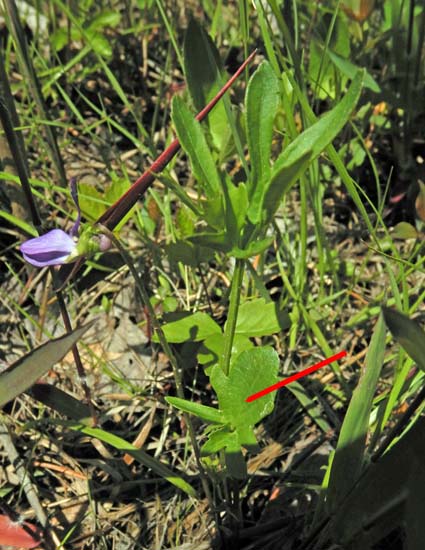
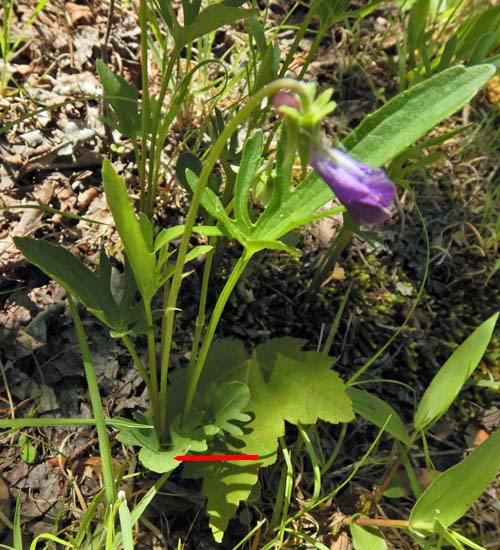
Early leaf with lobes.
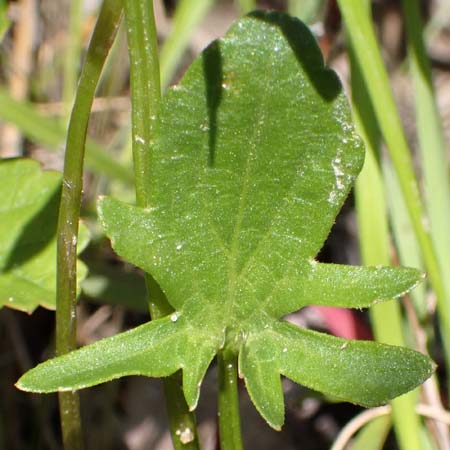
This early leaf is a little later, developing more of the primary characteristics.
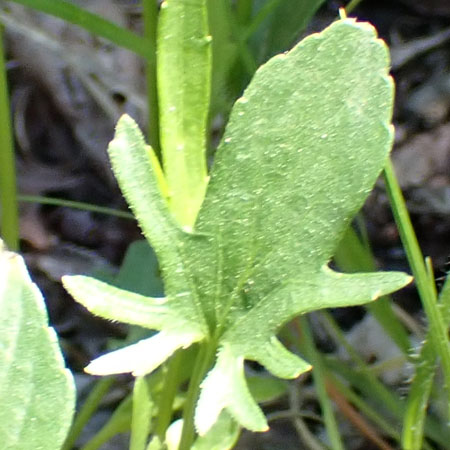
Primary - later leaves (taller leaves in top photos above). Photos of primary leaves below.

Flowers & Fruit
Britton's Coast Violet, Viola brittoniana - flower & fruit:
Several flower stalks can arise from the ground, each with a single flower at the top. The stalks curve downward at the top so the flower is slightly nodding. The flower has the characteristic blue-violet corolla with 5 petals - 2 upper, 2 lateral, and 1 lower lip. Also, it has 5 stamens and 1 pistil and 5 sepals.
General violet flower structure
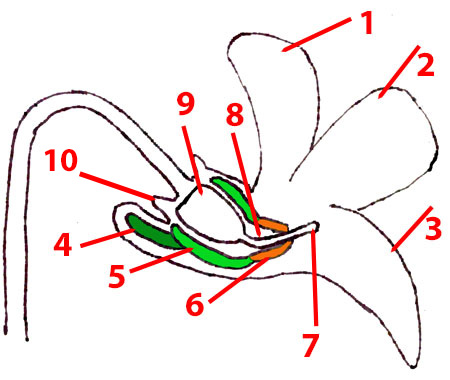
- upper petal
- lateral petal
- lower lip, back extends into a spur
- nectary structure: the lower two anthers have spur-like nectary glands on their back side and they extend into the spur of the lower petal
- anthers form a ring around the ovary
- anther appendage, brown/orange color, encircles the style; together with the anthers, a cone is formed around the ovary and part of the style; the anthers release the pollen into the interior of the cone.
- stigma, shape depends on species
- style
- ovary
- sepal with auriculate appendage at base
Key flower characteristics of Northern coastal violet, Viola brittoniana:
- flowers: relatively larger, about 3/4 inches across.
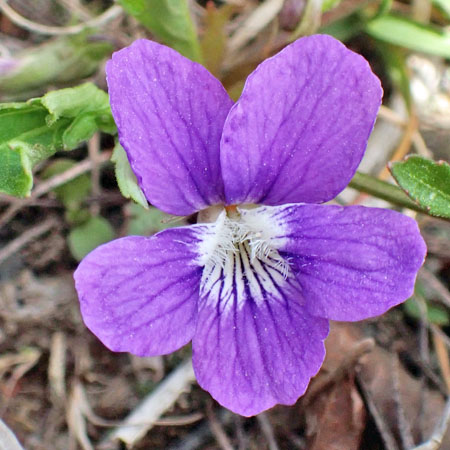
- petals: blue-purple with white at the base
- lateral petals: bearded with tuffs of fine hairs at the base
- lower petal: prominent dark purple veins from the center; slightly hairy; extended from the back is a short nectar spur
- stamens somewhat concealed (by hairs)
- stigma: expanded, not bearded, capitate with conical beak on the lower side. For an image, see Viola sagittata page.
- sepals are long lanceolate, narrow-acute to acuminate at the tip and hairless. This feature differentiates V. brittoniana from V. subsinuata and V. palmata.
- sepal auricles prominent
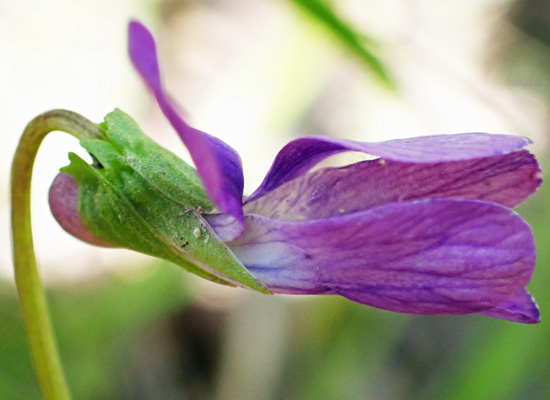
Flower photos below: front view - showing that the stamen (brown part) is barely visible (this distinguishes this from V. pedata); side views - showing long pointed sepals and large auriculate appendages (yellow arrows), short spur and no hairs. Also, no hairs on flower stalks (peduncles).
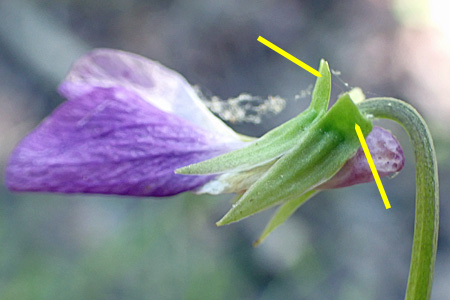

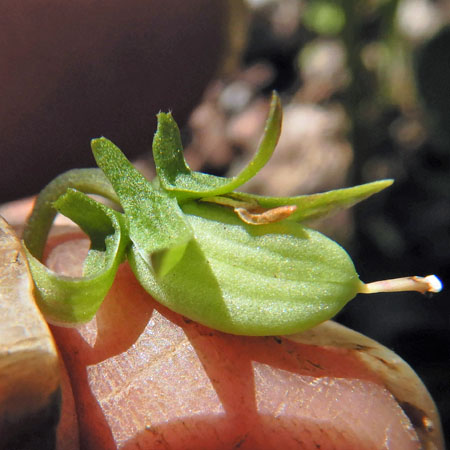
Developing fruit shows clearly the sepals and the large auriculate appendages.
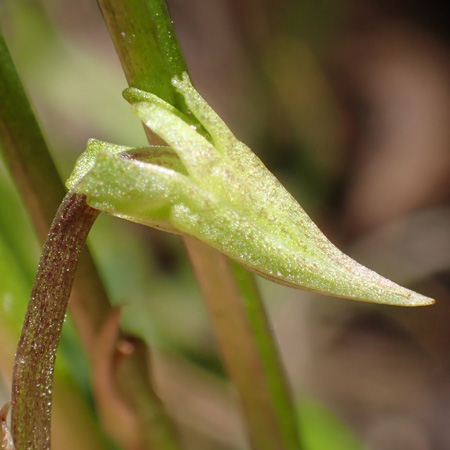
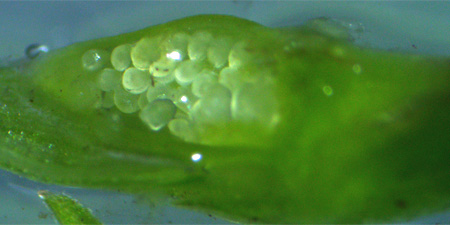
Cleistogamous flowers are not showy and do not have petals but they do have stamens and pistils. They never open so they self-fertilize and create seeds. In the photo the long pointed sepals and large auriculate appendage can be seen. They appear on its own flower stalk that is shorter that the normal flowers or taller leaves.
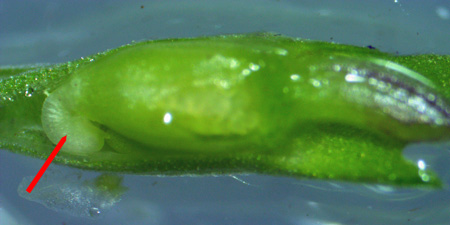
In the cleistogamous flower photos below, the sepals are removed. The upper photo shows the 'coiled style'. In the lower photo, the ovary is opened and the developing seeds can be seen.
Britton's Coast Violet blooms late April to early May. It is found at moist edges of floodplains/ marshes of freshwater and forest openings.
Violets are an important part of the eco-system: the flower provides pollen & nectar for early insects. Violets are the host plants for fritillary butterfly species - adults lay their eggs next to or on the violets and when the caterpillars emerge, they feed on the violet leaves. Birds eat the seeds and leaves and stems are eaten by some mammals.
Rarity
In NJ, Britton's Coast Violet, Viola brittoniana, is in the NJ List of Endangered Plant Species and Plant Species of Concern January 2024. It is S3: Rare in state with 21 to 100 occurrences. Frequently plants are rare in NJ but are common elsewhere. However, for this violet, it is globally rare: G3; Vulnerable.
There are two varieties of Viola brittoniana:
- Viola brittoniana var. brittoniana, Britton's Coast Violet. This is the variety discussed on this page.
- Viola brittoniana var. pectinata, Cut-leaf Coast Violet. This variety has leaves that are not lobed! It is S1 in NJ.
Text & diagram by Millie Ling and all photos by Hubert & Millie Ling. Photos: flowers April 25, 2025, May 19, 2025; fruit May 19, 2025; Middlesex County, NJ.
Additional information / References
Additional information / references:
- NY Natural Heritage Conservation Guide: Britton's Coast Violet: descriptions https://guides.nynhp.org/coast-violet/
- Ohio U. faculty and staff: descriptions https://people.ohio.edu/ballardh/vgpena/taxa/violabrittoniana.htm
- GoBotany: Viola brittoniana — coast violet; Gives violets that are confused with V. brittoniana https://gobotany.nativeplanttrust.org/species/viola/brittoniana/
- Flora of North America: descriptions http://https://floranorthamerica.org/Viola_brittoniana
-
Key to violets: New England has all the species of violets of NJ except it is missing one species that is stemless. This key is easier to use than the one below.
Go Botany Dichotomous Key to Viola https://gobotany.nativeplanttrust.org/dkey/viola - Flora of North America, Dichotomous Key to the Violets: http://www.efloras.org/florataxon.aspx?flora_id=1&taxon_id=134607
- NatureServe: Rarity https://explorer.natureserve.org/Taxon/ELEMENT_GLOBAL.2.134405/Viola_brittoniana
- NJ: Rarity https://nj.gov/dep/parksandforests/natural/docs/njplantlist.pdf