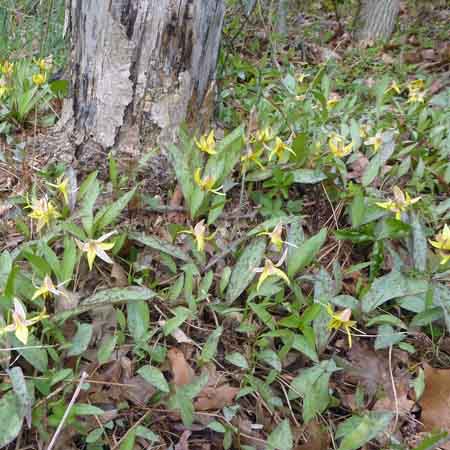
Erythronium americanum, trout lily, welcomes spring with its yellow flowers after years of just having leaves. It is a true spring ephemeral. It is a low growing native perennial plant found in woodland leaf litter. It has many other common names: fawn lily, yellow adder's-tongue, yellow dogtooth violet as well as American trout-lily and yellow trout lily.
Flowers
Flowers
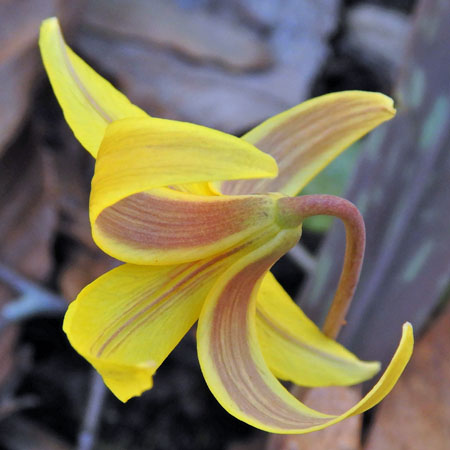
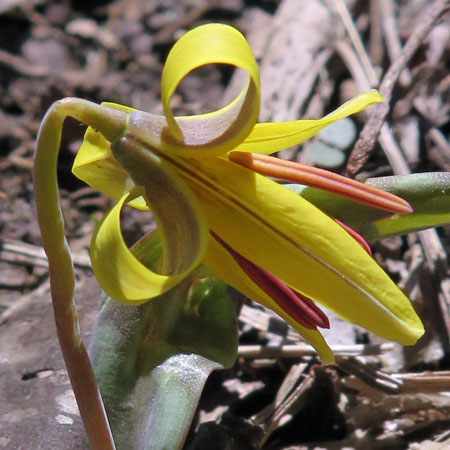
Trout lily (Erythronium americanum) sends out a single nodding flower at the end of a single leafless flower stalk of a mature plant. The stalk is about 4-10 inches tall.
Like other plants in the Lily family (Liliaceae) it has 6 tepals which are 3 inner petals and 3 outer sepals. The tepals are yellow with soft brownish/greenish streaks or spots. The outer surfaces is more brownish/greenish. The tepals are strongly reflexed when the flower is ready for pollination. The flowers close at night or on cloudy days. The tepals are about a inch and the flowers are about 2 inches across.
The flower has 6 stamens; the filaments are yellow and the anthers are yellow to brown to brownish red. After dehiscing (releasing pollen) the anthers are shriveled.
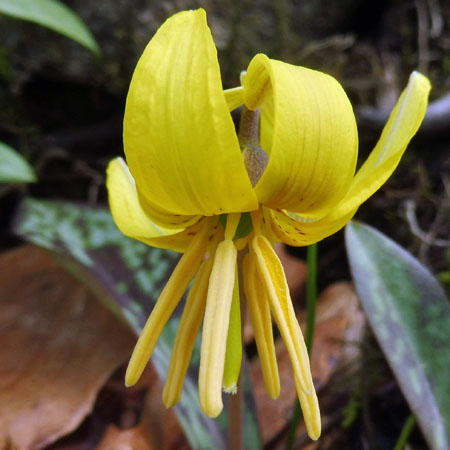
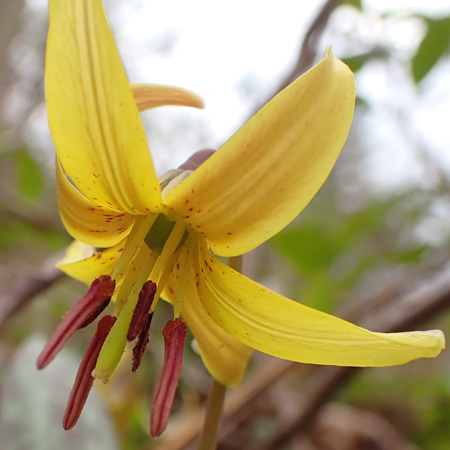
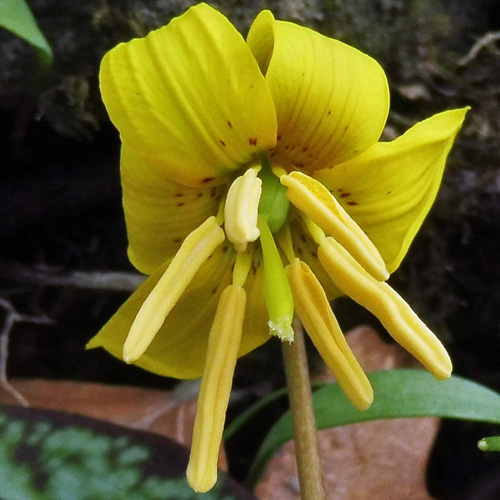
In the photo below, the 6 stamens are clearly seen as well as the pistil: green ovary, greenish yellow style and fuzzy stigma. Note also, two of the anthers are beginning to open to release pollen; the third is not showing. Generally, 3 anthers mature before the other 3. The flower provides both nectar and pollen to its early spring pollinators.
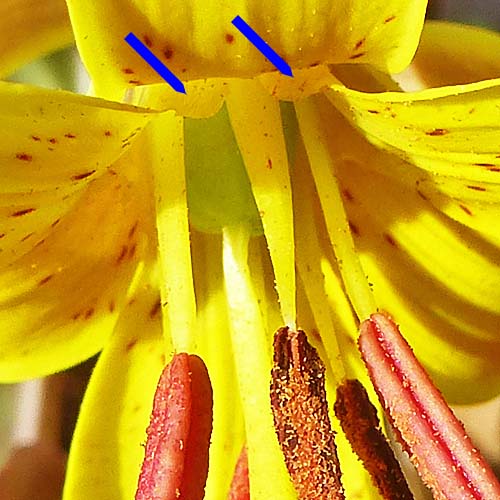
A close up of the flower: At the base of the inner tepals are 2 auricles (ears)(blue arrows). They are just small irregular lobes that distinguishes this species from E. umbilicatum.
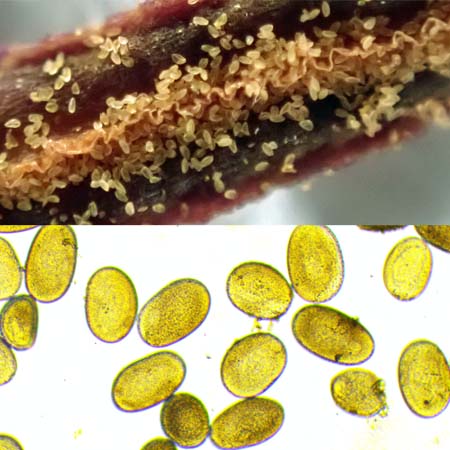
Close up of pollen on a dehisced anther and microscope photo of pollen. The pollen is oval.
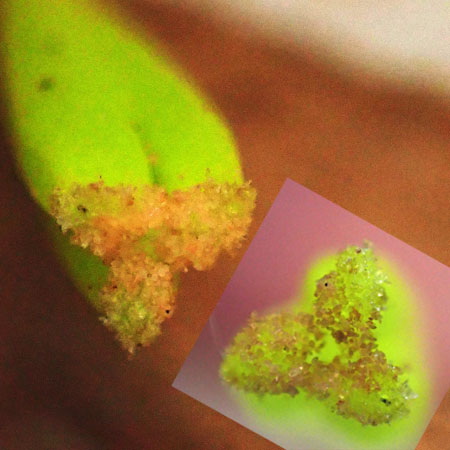
The stigma is 3 parted. A partial side view and an end view. Pollen is adhering to the surface.
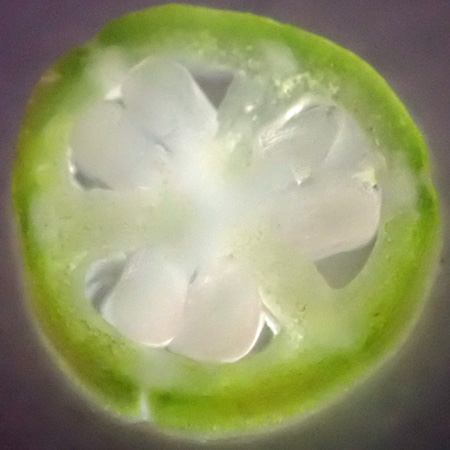
Cross-section of the ovary. It shows 3 compartments corresponding to the 3 lobes of the stigma. In the compartments, one layer of 2 ovules in each are shown. The ovules develop into seeds after fertilization.
Fruit
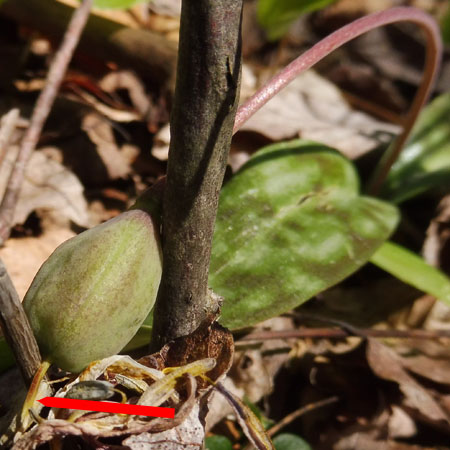
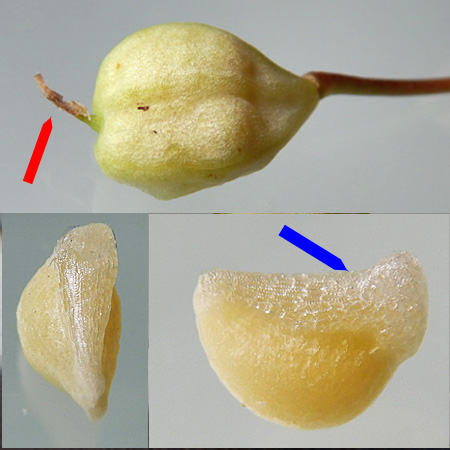
The trout lily (Erythronium americanum) fruit capsule is about half inch long. At some point the stem bends over and the capsule is on the ground. In the 2 photos below the red arrows point to the remnant style/stigma of the flower. It is not located in a depression in the fruit and it is this that distinguishes this species (E. americanum) from E. umbilicatum where the end is dimpled with or without the remnant.
In the bottom of the second photo below are 2 views of seeds and their elaiosomes (blue arrow). When the fruit matures, it opens and releases the seeds. Each seed has a small fleshy attachment, known as an elaiosome, that is rich in fats. Ants carry the seeds with the elaiosomes back to their nests, eat the elaiosomes, and discard the seeds in their trash area where the seeds can germinate. This facilitates dispersal and burial of the seed by ants which is known as myrmecochory.
Leaves
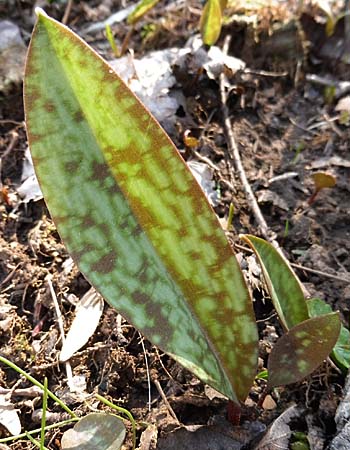
The leaves are basal and 3-6 inches long. The mottled pale green and brownish upper surface make the plant easy to identify. The lower surface is green.
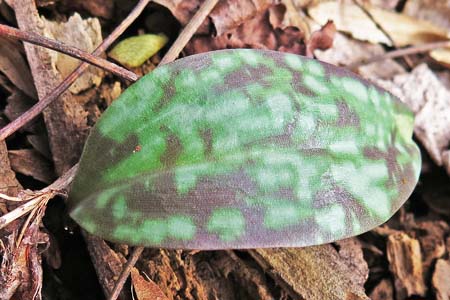
Plant - Habitat
Trout Lily (Erythronium americanum) fruit capsule is about half inch long. At some point the stem bends over and the capsu plant takes 4-7 years to bloom from seed. The mature plant (fertile) has 2 leaves and with the flower stalk is 5-10 inches tall. The immature plant has only a single leaf.
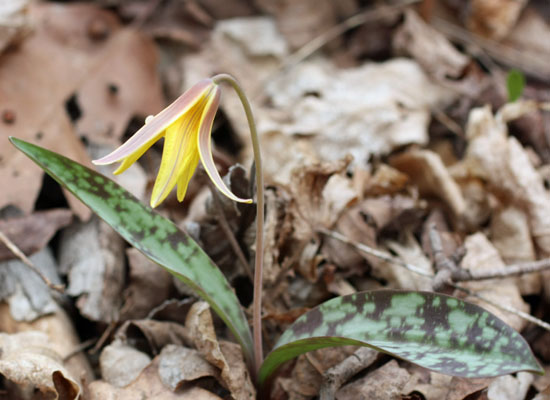
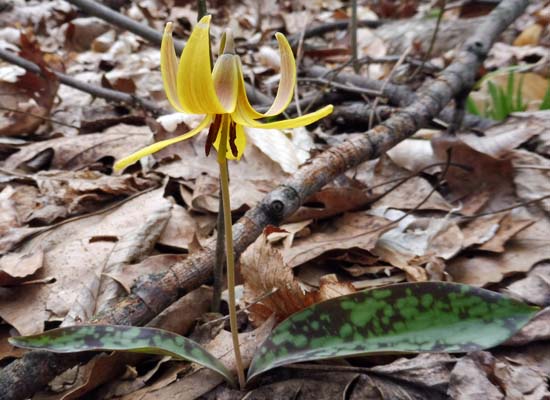
Populations of single leaf plants can be quite common and dense. Generally, the number of flowering plants is very much lower.
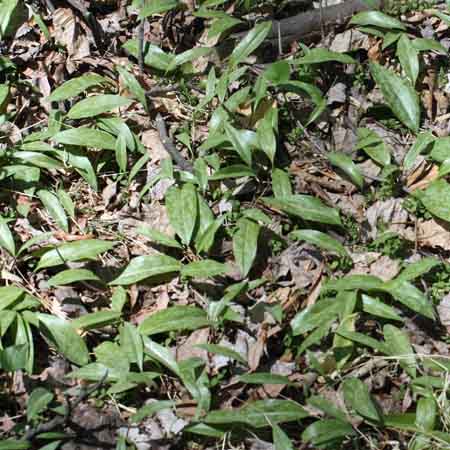
Growth cycle: The plant grows from a underground corm. A corm is a solid nutrient storage structure like a bulb. In order to have a mature plant the corm has to be large enough and deep enough around 7 inches. The depth provides a more stable temperature and water supply. It also is less likely to be dug up by animals. The larger size corm enables the plant to have enough energy to support flower and fruit formation.
To achieve maturity, a young corm sends out several white droppers ( stolon-like structures). A dropper reaches up to 10 inches away and digs down into the soil and forms a new corm at the tip which hopefully is deeper than the parent corm. The new corms receive nutrients from the parent corm and from its leaf. Later the parent corm dies. This process is repeated and results in a transfer of nutrients and the formation of a colony of clones (vegetative propagation) This is occurring during the 4-7 years!
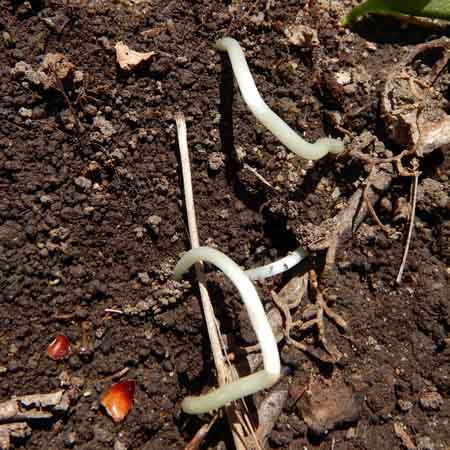
Generally, the mature plant with a corm at the right size and depth does not send out droppers. It focusses on flowering and seed production. Trout lily populations are known to be long lived.
Trout lily (Erythronium americanum) is a true spring ephemeral. It blooms in spring and its above ground activities are done by July. However, underground, there is still work to be done. Other true spring ephemeral include: Spring beauty, Cutleaf toothwort, Dwarf ginseng, and Dutchman's breeches.
Trout lilies are usually found in rich forests.
This trout lily (E. americanum) grows mainly in the NE. However, in the SE, there is another species, E. umbilicatum, that grows well and looks the same. The distinctions are the auricles in the tepals and the dimples at the end of the fruit as mentioned above.
Text by Millie Ling and all photos by Hubert & Millie Ling. Photos: Cultivation, Sourland Mt preserves, Lewis Morris Cty pk, Hidden Valley pk. Trout lilies are quite common and can be found in many preserves and parks.
Additional information
Additional information / references:
- Illinois Wildflowers: good description
https://www.illinoiswildflowers.info/woodland/plants/yl_troutlily.html - Virginia Native Plant Society: good information
https://vnps.org/wildflowers-of-the-year-2/2003-yellow-trout-lily-erythronium-americanum/ - Jackie Bailey Labovitz: Underground network
https://www.baileylabovitz.com/trout-lily#:~:text=Erythronium - The Origin and Development of Bulbs in the Genus Erythronium
https://www.journals.uchicago.edu/doi/10.1086/330378 - Vegetative Reproduction and Multiplication in Erythronium
https://www.jstor.org/stable/2478189