Chelone glabra, White Turtlehead, is a native perennial herbaceous plant that blooms in the fall and is usually found near fresh water.
Flowers
Inflorescence/Flower cluster:
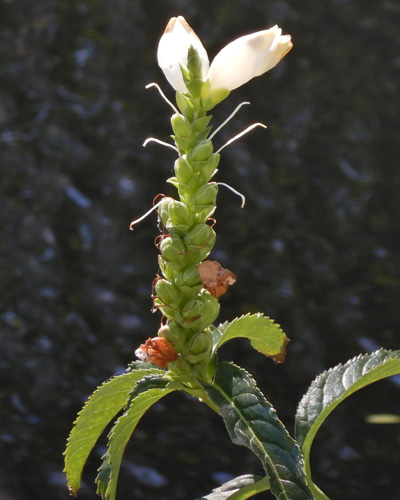
The white turtlehead's, Chelone glabra, inflorescence is a compact terminal upright spike up to 3 inches long. The flower spike forms at end of the main stem and smaller spikes form on stems arising from leaf axils in the upper part of the plant. The flowers form around the stem. A flower spike is a single stem with sessile flowers.
At the base of each spike is a pair of small leaves.
The flowers open from the bottom up so the lower flowers are finished first. The buds on top are quickly followed by blooming flowers so that the blooming flowers are clustered near the top.
Photo below: flower spike is just starting. Buds on top, mature flowers next, leaves at the spike base. Below each bud are a few modified leaves (bracts) that resemble the sepals.
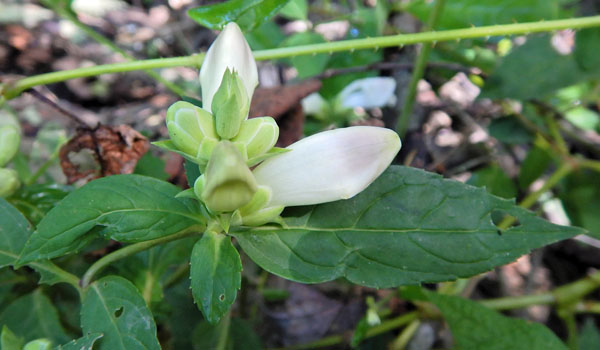
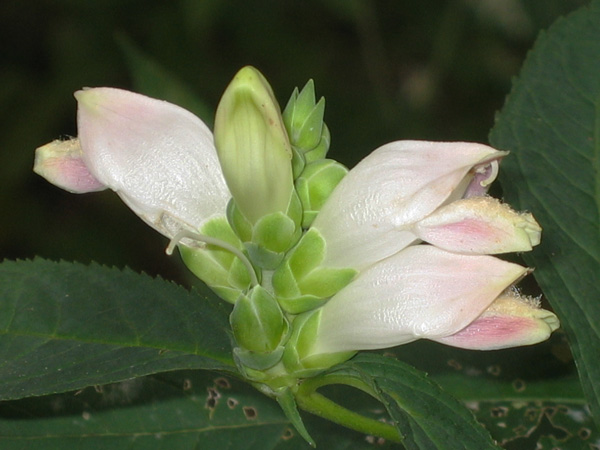
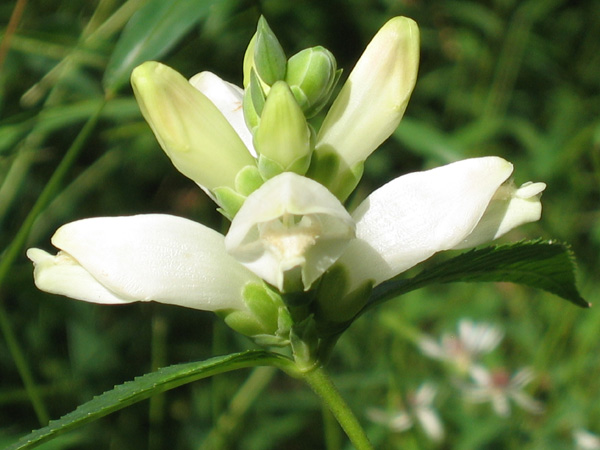
Photo below: spike is growing. The buds and mature flowers are clustered at the top. Below the mature flowers are the fruits with the style/stigmas persistent. The upper styles are still whitish while the lower ones are older and dark brown.
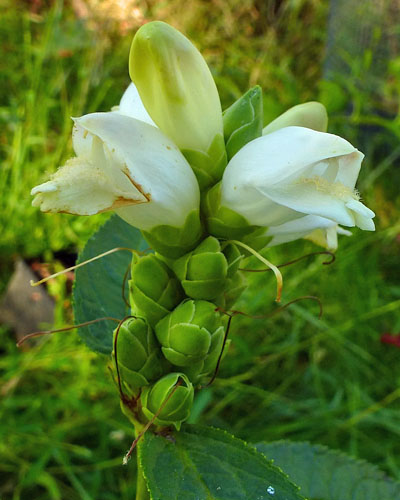
Here is a long spike. It appears that the flowers are always at the top of the spike. Buds only form just above the active flowers. I have seen up to 8 flowers in bloom at a given time near the top.
Individual Flower:
The flowers are 1 to 1.5 inches long and are creamy white and sometimes with a tinge of greenish yellow. The wide tubular corolla is formed from 5 fused petals. The upper helmet shaped lip is slightly double lobed. The lower lip has three lobes with the middle lobe slightly raised with long shaggy yellowish hairs at its base.
The green sepals are fused at the base with 5 broad lobes that hug the base of the corolla.
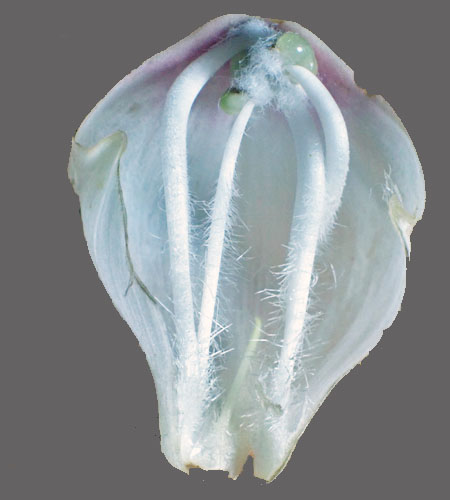
The flower has one style, 4 fertile stamens and one infertile stamen (staminode) with no anther.
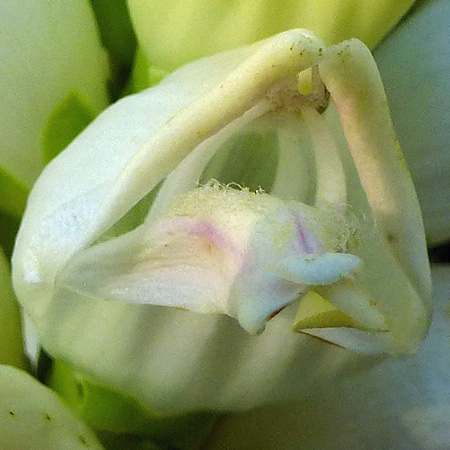
The fertile stamens have dense hairy anthers. The filament is hairy also especially at the base. The stamens are paired. The anthers of each pair come together near the top just inside of the corolla.
The staminode is greenish white and is much shorter that the fertile stamens.
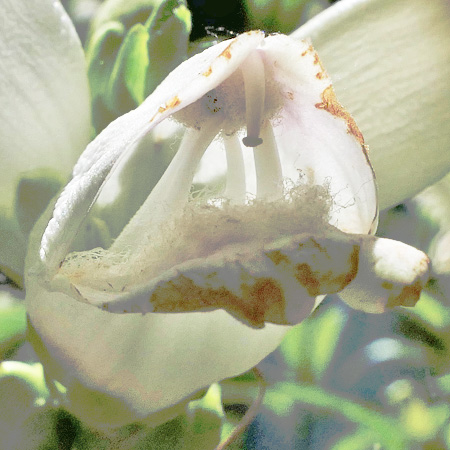
The style of the pistil appears just under the upper lip of the corolla and extends downward into the corolla opening when the stigma is receptive.
White turtlehead exhibits protandry to promote cross pollination and reduce self pollination. The pollen is released before the stigma is receptive. After the pollen is released, the stigma becomes receptive, elongates and bends downward to catch pollen from insects that have collected pollen from another flower.
The flowers are not fragrant. The flower provides nectar and pollen to its pollinators which are mainly bees strong enough to pry open the lips.
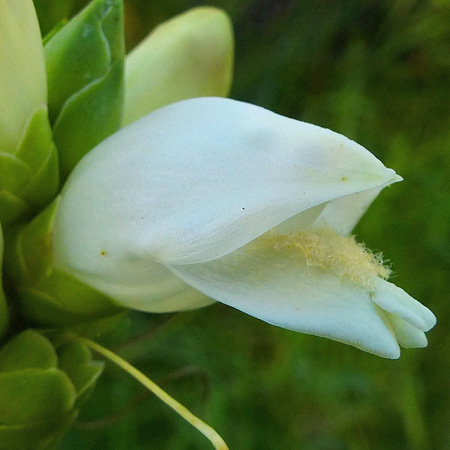
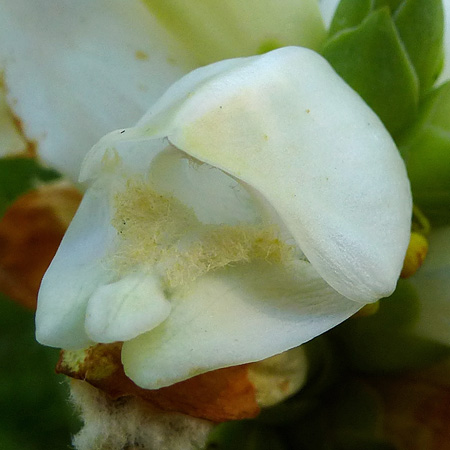
Looking inside the corolla: the style/stigma can be seen just below the top of the upper lip. In the older flower, the style is longer and bends downard.
Flower dissections:
With the upper lip (helmet) just raised a bit, 4 green glassy eye-looking structures appear. The green structures are anthers and they are all attached to each other in a sea of tangled white hairs. The long style/stigma appears above the anthers.
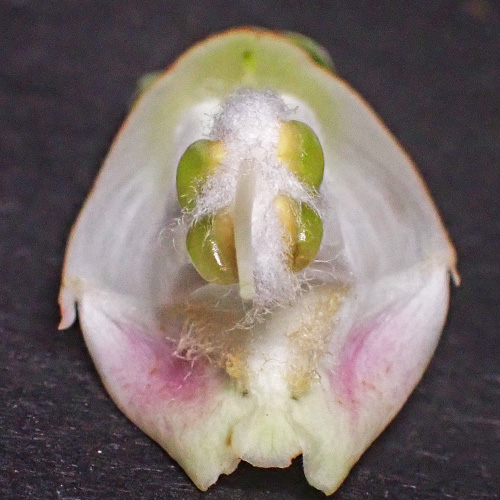
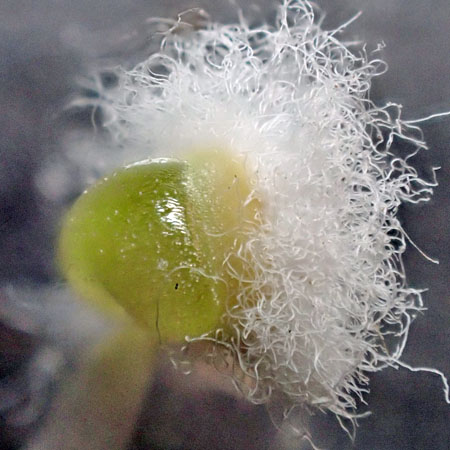
Another view with the upper lip partly cut off. The style/stigma is also merged into all the fuzz. The fuzzy collection of 4 anthers and style did not easily separate. The anthers are not fused, but held together by the tangle of hairs that come from the anther walls.
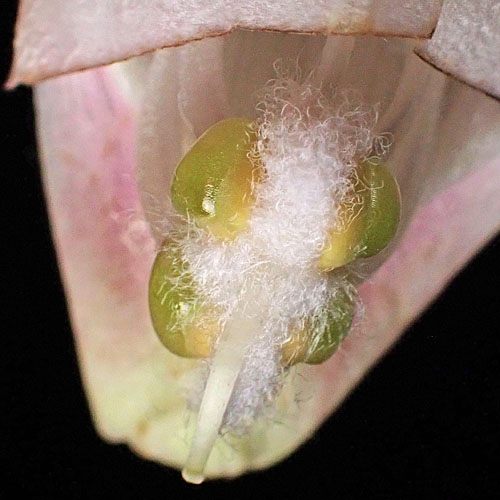
Top view with the style/stigma removed: showing how the pair of anthers come together from each side. The stamen pairs are arranged: inner and outer.
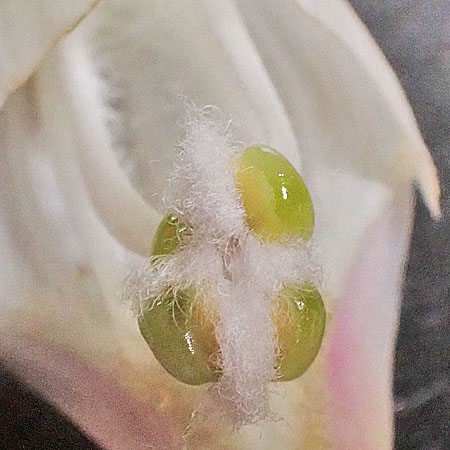
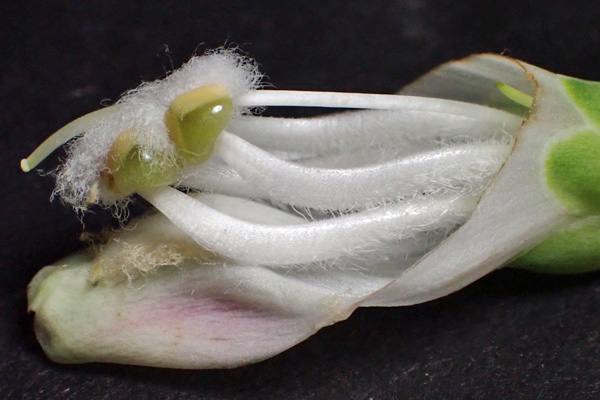
Side view with most of the upper lip cut off: The long white filaments of the stamen are also fuzzy with white hairs. The white style is smooth. Just at the place where the upper lip is cut, the green staminode can be seen. The stamens are didynamous meaning that the two pairs are not of the same length.
Another view of the anther: The tangle of hairs were not easily removed. The anthers open on the side opposing its pair.
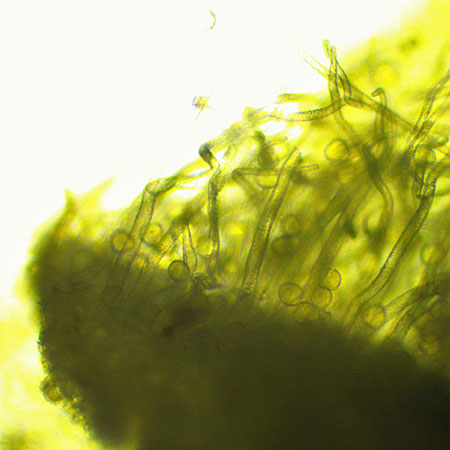
Micrograph of the hairs on an anther: Pollen can be seen in between the hairs.
The white turtlehead pistil consists of 2 carpels. A carpel is the basic female reproductive structure consisting of an ovary, style and stigma. These 2 carpels are fused into a single pistil. The cross-section photo of the ovary shows the fused two-carpel ovaries and their ovules. The ovules later form seeds. The two-carpel style/stigmas are well fused.
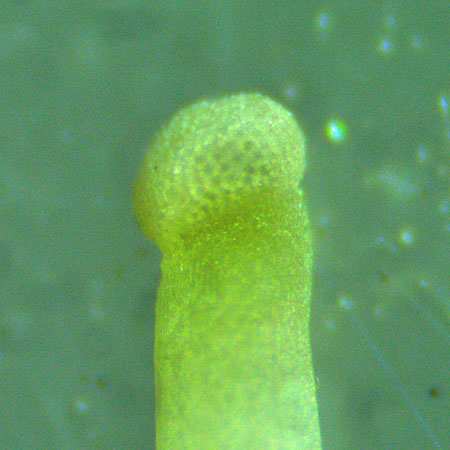
Micrograph of the stigma at the end of the style.
Micrograph cross-section of the ovary.
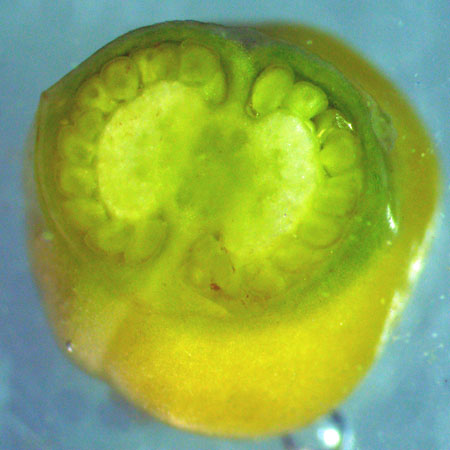
Photo: Green ovary with long white style and yellow nectary ring at the ovary base.
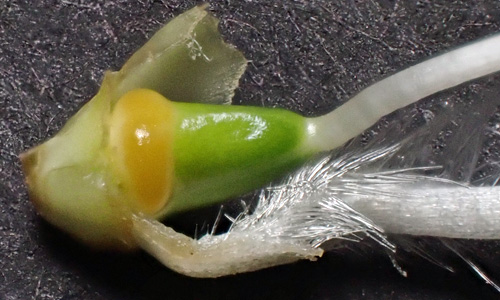
Photo: The staminode and the fertile stamens all originate at the base of the upper lip. Attachment to the petal is called epipetalous
Leaves
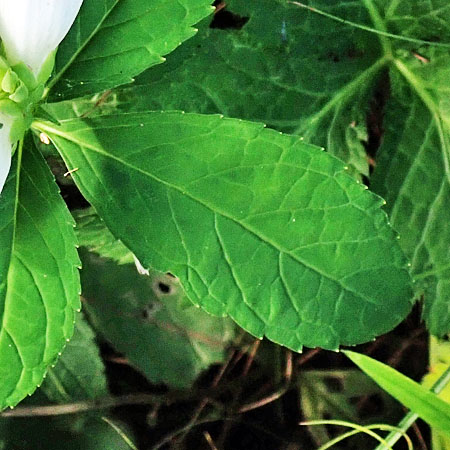
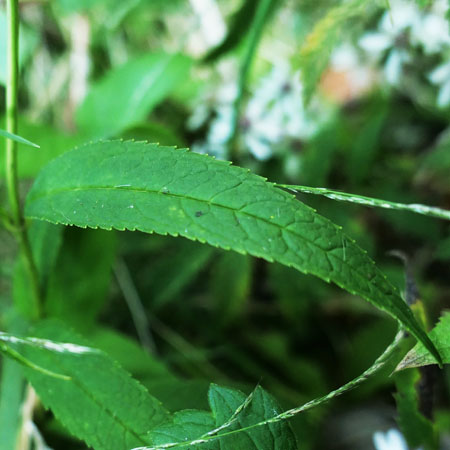
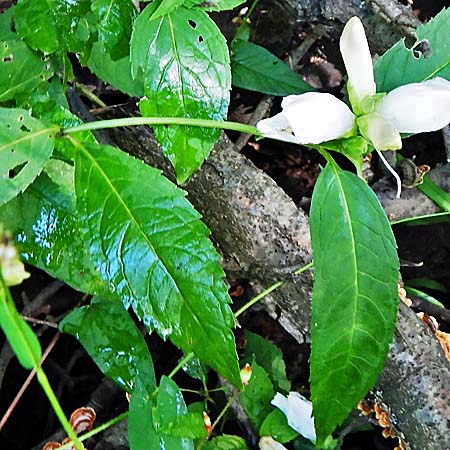
The leaves are opposite and short stalked or stalkless. Each pair of opposite leaves is rotated 90 degrees from the pair below. The leaf blade is unlobed, linear to lance egg-shaped, up to 8 inches long, and 1.5 inches wide. They taper to a sharp point at the tip. The upper and lower surfaces are hairless. The margins are finely toothed with sharp, mainly forward-pointing teeth
Plant
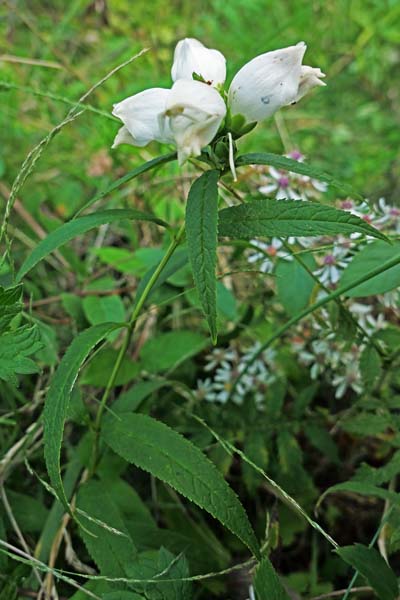
The plant grows to 2 to 3 feet tall, mostly erect. The stem is hairless and mostly unbranched below the inflorescence. The stems are square but have rounded angles, sometimes causing the stem to appear round.
Text by Millie Ling and all photos by Hubert & Millie Ling. Dissections by H. Ling. Photos: flowers mid September, cultivation, Patriots Trail Morristown area, Delaware & Raritan Canal State Park trail.
Additional information
Additional information / references:
- The USDA website shows Chelone glabra distribution in the US and other information: https://plants.sc.egov.usda.gov/plant-profile/CHGL2
- Reproductive Systems in Chelone glabra var. glabra: https://scholarworks.uni.edu/cgi/viewcontent.cgi?article=1996&context=pias
- Pollination ecology and floral visitor spectrum of turtlehead (Chelone glabra L.; Plantaginaceae) Richardson, L. L., & Irwin, R. E. (2015). https://pollinationecology.org/index.php/jpe/article/view/354/127
- Plants of the Eloise Butler Wildflower Garden https://friendsofeloisebutler.org/pages/plants/whiteturtlehead.html
- GoBotany https://gobotany.nativeplanttrust.org/species/chelone/glabra/
- Virginia Native Plant Society: Wildflower of the Year 2024 White Turtlehead: https://vnps.org/wildflower-of-the-year-2024-white-turtlehead-chelone-glabra/
- Minnesota Seasons - white turtlehead https://minnesotaseasons.com/Plants/white_turtlehead.html