Whorled milkweed, Asclepias verticillata, is an upright native perennial herbaceous plant. Like all milkweeds, it is a great source of nectar for its pollinators and other insects. It differs from most milkweeds by its whorled long very narrow needle-like leaves. It blooms in July.
Flowers
Inflorescence/Flower cluster:
The flower clusters emerge terminally on the stem and from the axils of the upper leaves. The inflorescence is an umbel (flowers spreading from a common point). Each umbel is about 2 inches across with 7-20 stalked flowers.
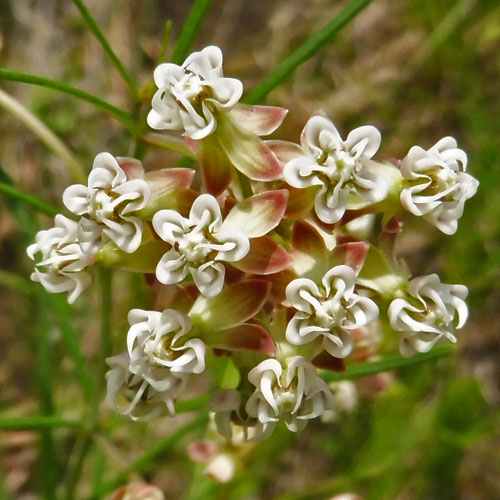
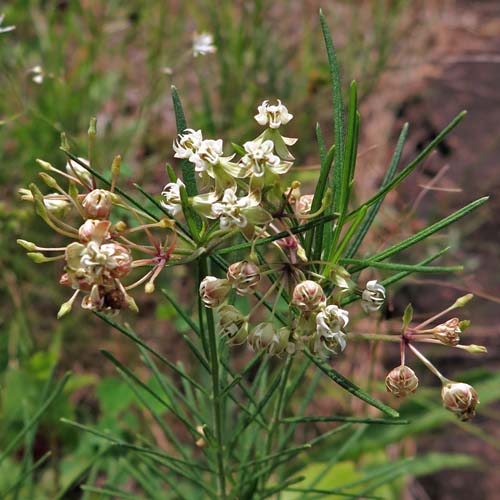
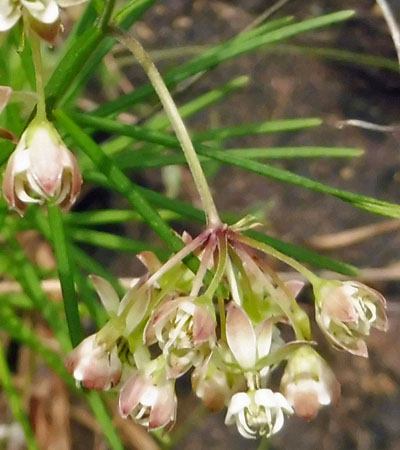
A single cluster of mainly immature flowers hangs from a leaf axil. The sepals can barely be seen.
Individual Flower:
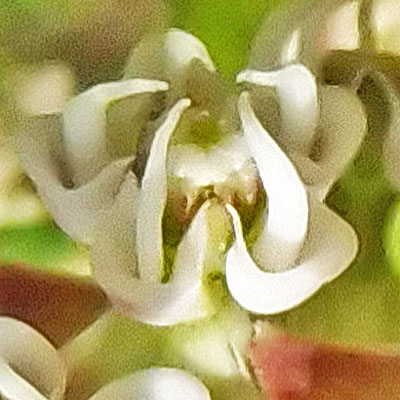
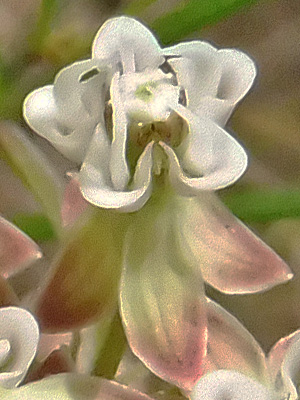
Each flower is about 1/3 inches across. The flower has 5 petals and 5 sepals. The sepals are pale green and the petals are white or greenish white sometimes with pale purplish tints toward their tips. The rest of the flower is mainly white. It exhibits the usual milkweed structure. What is the usual milkweed flower structure? Where are the reproductive structures of milkweeds? How does pollination occur? See our detailed description on our common milkweed (Asclepias syriaca) page. Click Here, opens in separate tab
Plant - Leaves
Plant: Whorled milkweed is an upright perennial 1-3 feet tall. The stem is usually unbranched until the inflorescence.
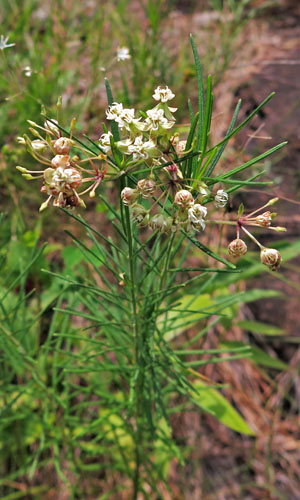
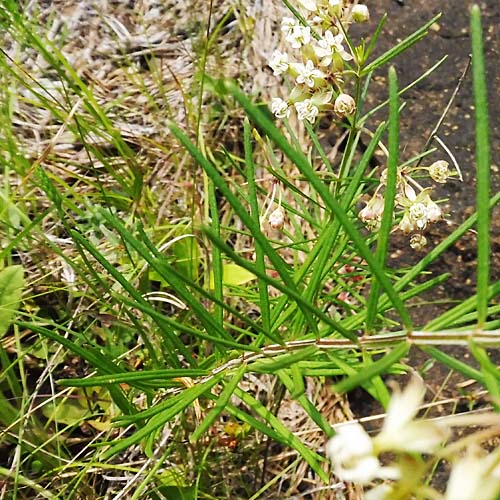
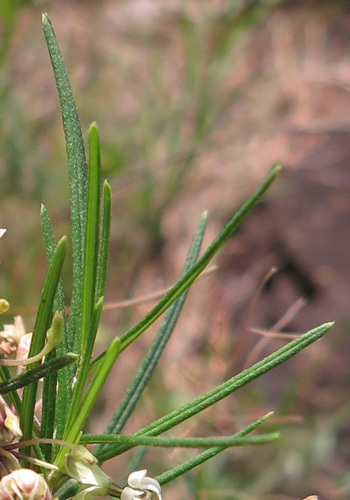
Leaves: They occur as a whorl of 3-6 leaves and there are many whorls producing an abundance of leaves. Sometimes the leaves are just opposite. The leaves are linear - long and narrow and are 2-3 inches long and 2-3 mm wide. The margins are smooth. The upper surface is glabrous to sparsely short hairs with a narrow grove along the middle. The leaves are sessile or have very short petioles (leaf stalks).
Like other milkweeds, when the leaves or stems of whorled milkweed are broken, they produce a milky latex. This liquid contains various levels of toxic cardiac glycoside compounds which makes the plants toxic to most insects and animals. It is more difficult to see in this plant because the leaves are so narrow.
The stems have lines of fine hairs.
Rarity: In New Jersey, whorled milkweed, Asclepias verticillata, is imperiled - S2, (2026) but globally secure G5. Inaturalist observations, 42, were mainly in central/north Jersey (2026). Unfortunately, many of the observations are obscured, in some ones yard, or planted.
Text by Millie Ling and all photos by Hubert & Millie Ling. Photos: serpentine barrens, NC - July 17, 2018
Additional information / References
Additional information / References:
- Illinois Wildflowers
https://www.illinoiswildflowers.info/prairie/plantx/wh_milkweedx.htm - MissouriPlants
https://missouriplants.com/Asclepias_verticillata_page.html - Arkansas Native Plant Society
https://anps.org/know-your-natives-whorled-milkweed/ - NatureServe - rarity & distribution.
https://explorer.natureserve.org/Taxon/ELEMENT_GLOBAL.2.146524/Asclepias_verticillata - Key to NJ Milkweeds, New England has almost the same milkweeds as NJ: GoBotany.
https://gobotany.nativeplanttrust.org/dkey/asclepias/#all - Jersey Friendly Yards: great horticulture information.
https://jerseyyards.org/plant/asclepias-verticillata/