Red milkweed, Asclepias rubra, is an upright native perennial herbaceous plant. The showy flowers are pink rather than red as the common name would suggest. Other common names include: tall pink bog milkweed and purple savanna milkweed. It blooms late July, August.
Flowers
Inflorescence/Flower cluster:
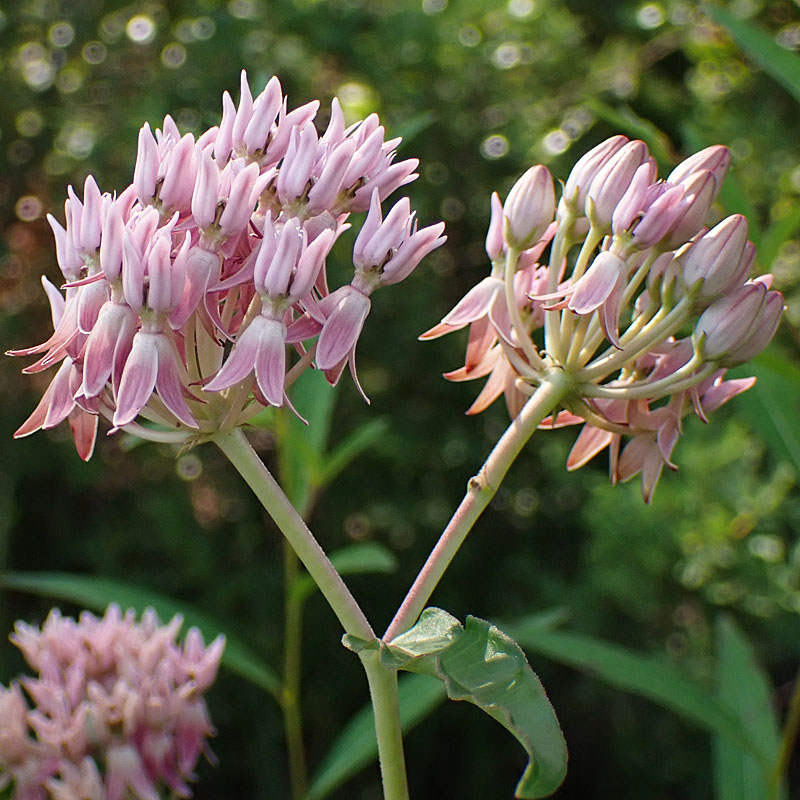
The flower clusters emerge from the top of the stem or branched stem. The inflorescence is an umbel (flowers spreading from a common point). Each umbel is about 1.5 inches across with 9-20 stalked flowers.
Individual Flower:
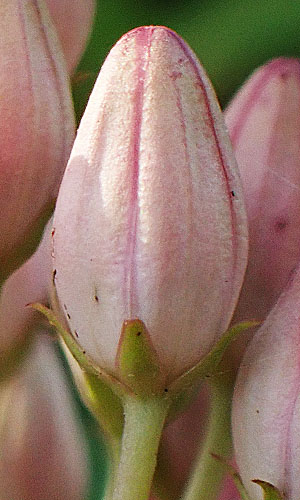
Each flower is about 1/4 inches across. The flower has 5 petals and 5 sepals. The sepals are pale green and the petals are pink to purplish pink.
This flower exhibits the usual milkweed flower structure which is very distinctive. What is the usual milkweed flower structure? Where are the reproductive structures of milkweeds? How does pollination occur? See our detailed descriptions on our common milkweed (Asclepias syriaca) page. Click Here, opens in separate tab
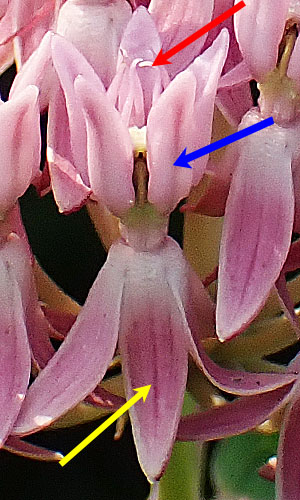
Flower petals (yellow arrow). The hood (blue arrow) and horn (red arrow) form the corona of the flower. The hoods and horns are the pink like the petals.
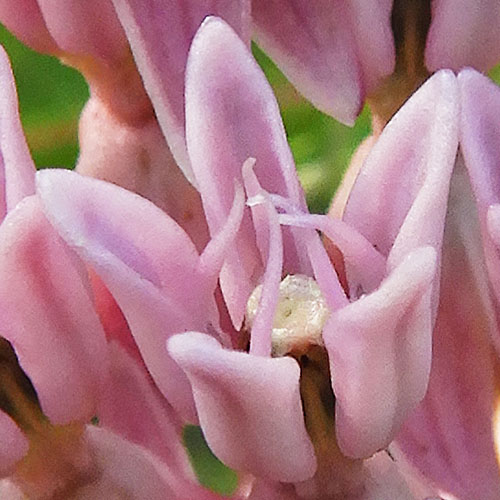
It is easy to see that the milkweed flower is unusual. The center is the gynostegium with a white top.
Flower bud showing sepals at the base.
Plant - Leaves
Plant: Red milkweed is an upright perennial plant growing to 2 to 3 feet tall. The single stem is usually unbranched until the inflorescence.
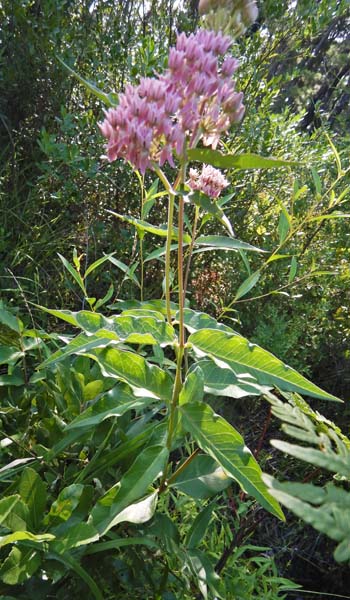
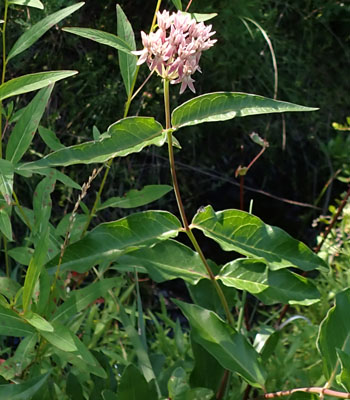
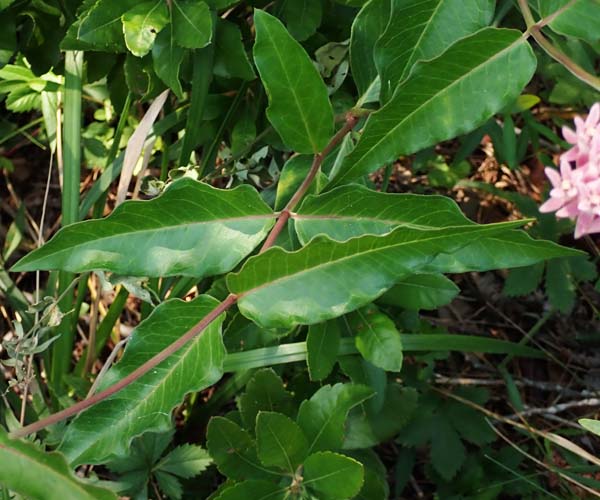
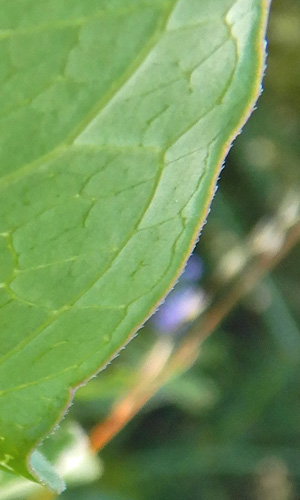
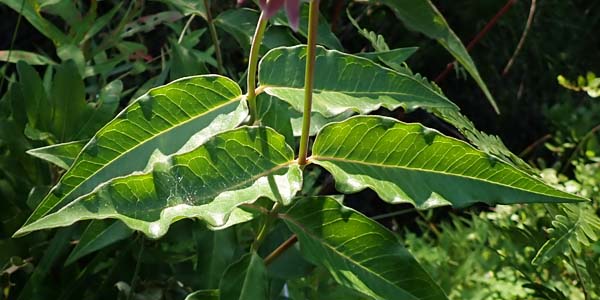
Leaves: The leathery leaves are opposite and sessile or almost sessile. They are lanceolate (wider below the middle and tapers to a point at the tip). The leaf base is rounded or slightly heart shaped. The margins are wavy and slightly hairy. The leaves are 3 to 5 inches long.
Like other milkweeds, when the leaves or stems of red milkweed are broken, they produce a milky latex. This liquid contains various levels of toxic cardiac glycoside compounds which makes the plants toxic to most insects and animals.
Rarity: In New Jersey, red milkweed, Asclepias rubra, is imperiled - S2, (2026) and globally only apparently secure G4. Even though red milkweed is native to many states, its prescence is only in a few counties in each of those states.
Text by Millie Ling and all photos by Hubert & Millie Ling. Photos: Pine Barrens, NJ - July 2026
Additional information / References
Additional information / References:
- Flora of the Southeastern United States
https://fsus.ncbg.unc.edu/show-taxon-detail.php?taxonid=4884 - Flora of North America
https://floranorthamerica.org/Asclepias_rubra - NatureServe - rarity & distribution.
https://explorer.natureserve.org/Taxon/ELEMENT_GLOBAL.2.151991/Asclepias_rubra - USDA plants: native distribution down to the county level.
https://plants.sc.egov.usda.gov/plant-profile/ASRU - Key to NJ Milkweeds, New England has almost the same milkweeds as NJ: GoBotany.
https://gobotany.nativeplanttrust.org/dkey/asclepias/#all