Amaranthus pumilus, seaside amaranth, is an annual plant that is native to coastal beaches along the Atlantic Ocean from New England down to South Carolina. It is not only rare in NJ or also rare globally.
Plant
Plant:
Seaside amaranth grows on the beach in the sand above high tide away from the water. We've seen them where they would be easily trampled by beach goers and where stormy waves may occasionally wipe them out.
The plant is prostrate and forms mats.
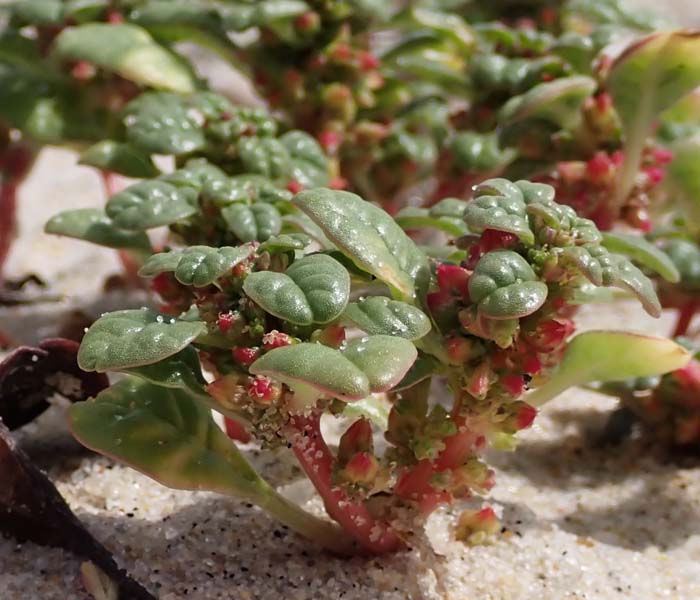
The stems are fleshy, reddish, smooth, and somewhat stiff. Multiple stems branch from the base and they can be quite long. The plant branches into a low-growing rosette of leaves with 5 to 20 branches and the plant usually reaching 4 to 12 inches in diameter and a few inches tall. Occasionally a plant may reach a yard or more across, with a hundred or more branches.
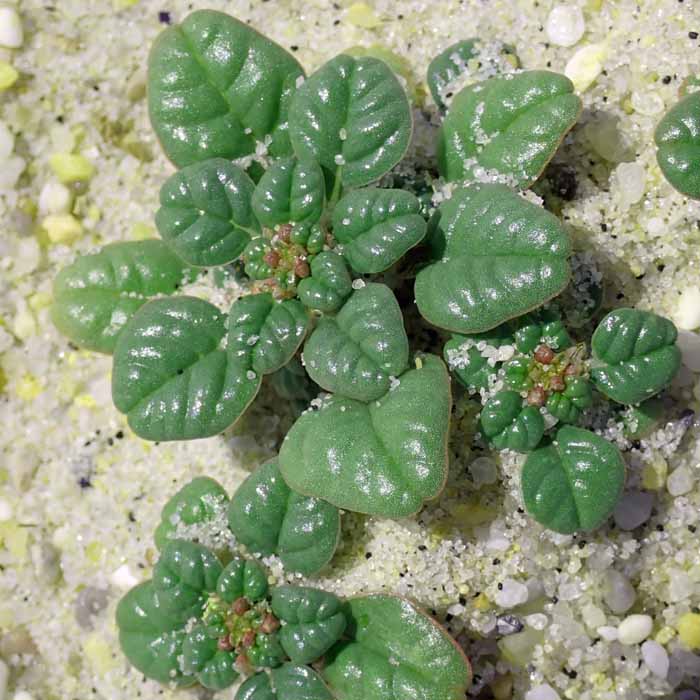
The leaves are petiolate (have stalks) and are alternate. The leaves form more toward the top of the branches. The leaves are round, fleshy, about an inch long with a shallow notch at the tip. Very notably, the leaf veins are indented giving the puckered-look like spinach but firm.
In NJ, seaside amaranth is S1 critically imperiled and globally G2 imperiled. There is much conservation efforts to protect and restore this plant.
Flowering begins when plants have reached sufficient size around July and continues until the plant dies in late fall or early winter.
Top view of small plant about 5 inches across.
Side view under the top leaves: plant about 2 inches tall.
Flowers
Inflorescence, flower clusters
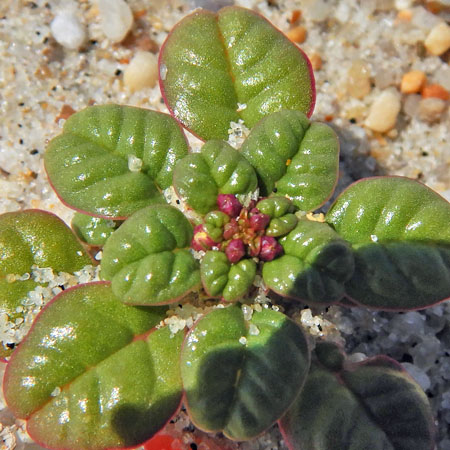
The Amaranthus pumilus inflorescence is a compact cluster of tiny flowers in various stages of development on leaf axils.
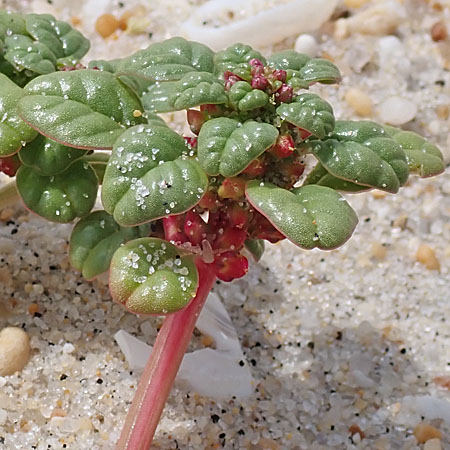
At the center top of the whorl of leaves is a compact cluster of tiny reddish flowers. Also, there were clusters of tiny reddish flowers below the top level of leaves. Not many flowers were open in the clusters when we observed them.
Male Flowers:
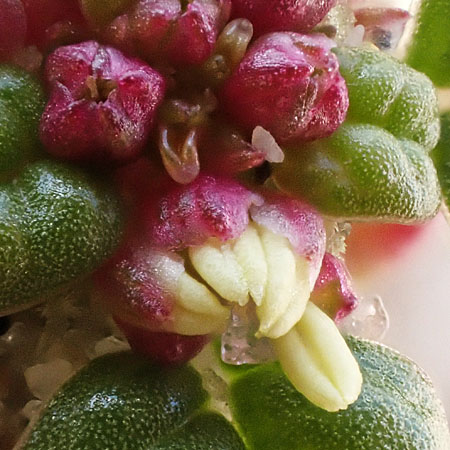
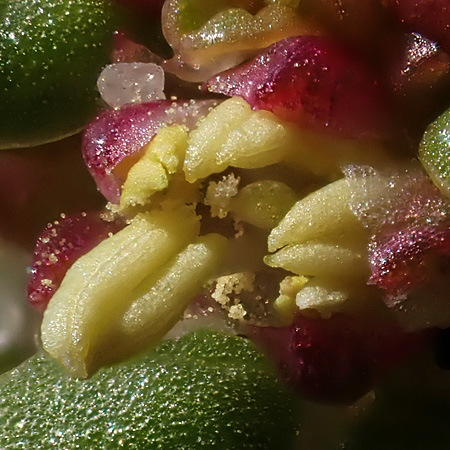
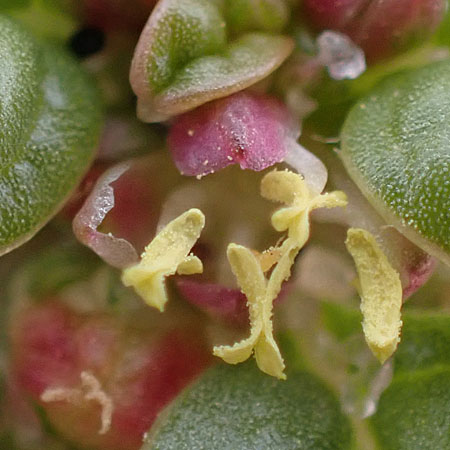
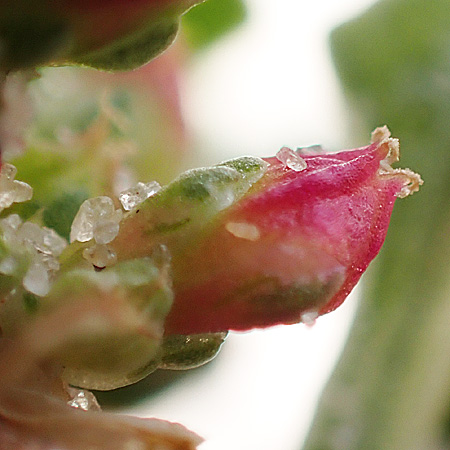
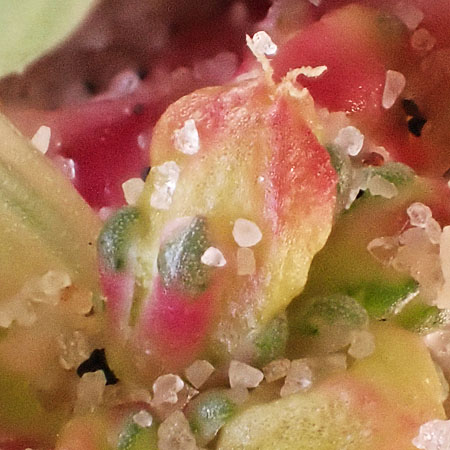
The seaside amaranth male flowers have 5 tepals and 5 stamens. In the photos below, the 5 reddish tepals can be seen especially in the buds. The 5 stamens are at different levels of development. Some of the yellow anthers are large and some small. In the second photo below, inside the male flower a pistillode (non-fertile pistil) can be seen. In the third photo, the anthers have dehisced and pollen can be seen. The fifth anther was not always apparent.
Female Flowers:
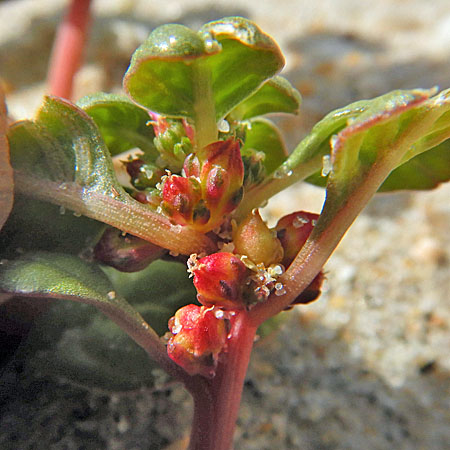
The seaside amaranth female flowers have 5 reddish tepals and 1 compound pistil of 3 carpels. The flower barely opens and the tepals are almost closed. Only the 3 yellowish white stigmas extend beyond the tepals. Outside of the reddish tepals are some bracts that are reddish and sometimes green tipped. The bracts are shorter than the tepals and look almost connected to the tepals. Most of the mature female flowers were under the top layer of leaves.
Seeds
Seeds:
Seed are produced starting in summer and usually peak in September and continue until the plant dies. The plant over winter as seeds.
Seaside amaranth seeds are dark reddish brown, shiny, and about 2.5 mm, one tenth of an inch in diameter.
The seeds are formed inside fruits called utricles. The utricle is a one-seeded fruit that does not split open at maturity (indehiscent). It is ovoid, fleshy, 4-6 mm, bladder-like, or inflated wall (pericarp). The utricle contains an air pocket.
For seaside amaranth, the utricle plays an important role in its seed dispersal. Dispersal is mainly by wind and water.
For long distance dispersal, the seed remains in the utricle which is light weight and has an air pocket so that it can float or blow over long distances to suitable habitats. This occurs during major storms.
For shorter distance disposal, the seed gets removed from its utricle
Text by Millie Ling and all photos by Millie & Hubert Ling. Photos: August 21 2026, Sandy Hook, NJ.
Additional information & References
Additional information / references:
- Flora of Southeastern US (FSUS): https://fsus.ncbg.unc.edu/cust/2023/main.php?pg=show-taxon.php&plantname=Amaranthus+pumilus
- US Fish & Wildlife Service (FWS): https://www.fws.gov/species/seabeach-amaranth-amaranthus-pumilus
- NC State U. Herbarium: https://herbarium.ncsu.edu/rare/images/Amaranthus_pumilus_NHP.pdf
- NJ Dept of Environmental Protection news release: https://dep.nj.gov/newsrel/18_0096/
- NJ Conservation Foundation: https://www.njconservation.org/is-that-spinach-no-its-rare-seabach-amaranth/